Showing posts with label Santa Clara Valley. Show all posts

Tuesday, August 23, 2011

2007 Sarah's Vineyard Chardonnay, Santa Clara Valley

0 comments
In 1977 Marilyn Clark and John Otterman bought a 10 acre property off Hecker Pass Road. They planted 7 acres of Chardonnay and named it Sarah's Vineyard. The first Estate vintage was made in 1983. The winery quickly established a reputation for wines of richness and depth with good aging potential. The winery stood apart from its neighbours, at a time when most of Santa Clara valley was producing cheap 'jug' wine. No expense was spared; even the labels were reportedly printed on stock normally reserved for wedding invitations, printed by a company that produced banknotes using a custom die made by an engraver from Smith & Wesson. However as time went on the price increased drastically while the quality became more variable. By the late 1990s the Estate Chardonnay cost $45 or more a bottle, but was only getting 80 points when reviewed by Wine Spectator.

In 2001 the winery was purchased by Tim Slater, who set about revitalising both the vines and the brand. The estate vineyards were replanted or retrellised, the buildings were renovated and extended, and a stack of brand new high-tech equipment was installed including a neat compact bottling line and a small but sophisticated laboratory. The winery currently produces Chardonnay and Pinot Noir from their estate vineyards and the Santa Cruz Mountains. They also source a range of Rhone varieties from the nearby Besson Vineyard, itself notable for providing Grenache to Bonny Doon's Cigare Volant for over 20 vintages.

The good news is that the 2007 Sarah's Vineyard Estate Chardonnay is far more reasonably priced than it would have been 10 years ago - $30 at the winery, but I've seen it as low as $20 at retail. It shows lots of toasty oak on the nose; On the palate there's apricot, lemon, cream and vanilla, with a rich, almost oily mouthfeel. The oak is very prominent on the finish. Despite its youth this bottle was already starting to show some mature notes; given the low acidity I wouldn't plan on holding it for more than another year. 88

Thursday, September 30, 2010

Santa Clara Valley Passport Weekend

0 comments
The Wineries of Santa Clara Valley are holding their autumn Passport event this weekend, October 2nd and 3rd. For those more familiar with the Santa Cruz Mountains events, this is more like the SCMWA Vintners' festival than their quarterly passport program.

A passport costs $30, includes a souvenir glass and is valid for both days only. All the member wineries will be open from 11-5PM both days, and may have additional promotions, refreshments and entertainment. This is a great opportunity to visit some of the less well known local producers.

In addition Aver Family Vineyards will be pouring at D’Vine Jazz & Wine from 12-5PM and at Westside Grill from 11–5PM both days. They may also be joined by Mann Cellars - who poured at both locations in March - though this is unconfirmed.

Wednesday, August 18, 2010

Burglaries at Santa Clara Valley Wineries

0 comments
As if our local wineries didn't have enough to worry about with the economic downturn and the unusually cool weather, it seems that they are increasingly being targeted by burglars. Over the past year at least 7 Santa Clara Valley wineries have been robbed - that's around a quarter of the total. Just this month two more were attacked, with the thieves causing significantly more damage than the value of items they took.
Fortunately one of the targeted wineries had installed hidden security cameras and the thief was photographed.

Tuesday, May 25, 2010

Relyea-Wood Vineyards

0 comments
Noël Relyea and Bill Wood are retired biochemists who own a beautiful property off Monte Bello Road. The property is located half a mile up a narrow dirt track close to the old Montebello school. It is situated on a ridge at around 1900 feet, with an incredible view west across the whole valley. The winery is in an annex separate from the main house, replete with shiny new steel tanks and a crusher/destemmer powered by solar panels on the roof.

In 2005 they worked with with Ron Mosley, the vineyard manager at Cinnabar, to install a picturesque vineyard on a half-acre of hillside behind their home. Unlike many small vineyard owners who have wine produced by sharecrop or custom crush facilities they decided to established their own bonded winery and do everything themselves. After all, as experienced biochemists they were already familiar with the principles.

2008 they saw their first harvest which yielded just 35 cases. To augment the estate fruit they also purchased Syrah from Santa Clara Valley and Cabernet Sauvignon from the Sacramento Delta. The latter wines were released in May 2010 and almost instantly sold out. The 2008 estate Cabernet Sauvignon is scheduled to be be released next year.

The couple are also keen astronomers; the winery even has its own observatory dome. In keeping with this the screen-printed bottle designs each incorporate a diagram of a constellation - the Syrah carries Ursa Major, while the estate Cabernet Sauvignon carries Orion - accompanied by a quote from Leonardo da Vinci: The discovery of a good wine is increasingly better for mankind than the discovery of a new star.

For 2008 the total production for all three wines was less than 100 cases. For 2009 the winery purchased Cabernet Sauvignon from Mount Veeder in Napa and a neighbouring vineyard as well as the Santa Clara Valley Syrah, so the total production should be around 150-200 cases. The target production for the winery is a scant 200 cases a year; although the winery could theoretically handle more the barrel room is rather tiny, and that's as much as Noël and Bill currently feel comfortable with.

2008 "Summertime" Red Table Wine, California
100% Cabernet Sauvignon, sourced from the Tamayo Family Vineyard in Brentwood. As the name suggests it's a lighter styled wine, with a dusty, bramble jelly nose. On the palate there's plenty of smooth blackcurrant fruit with some floral notes and just a little oak. Very reasonably priced at $12. Only 32 cases made. 88

2008 Syrah, Mosley Vineyard, Santa Clara Valley
The fruit comes from vineyard manager Ron Mosley's own vineyard in Morgan Hill. Primary and malolactic fermentation took place in tanks before being pressed and transferred to the barrel room downstairs, where it rested in new French oak for 11 months. Dark in colour with plum and spice on the nose. Quite intense; concentrated sweet fruit backed by white pepper and plenty of tannin. Perhaps a little riper than I would prefer, but an excellent first effort and very well priced at $30. I plan to revisit this in 6 months or so. Only 14 cases made. 92+

2009 Cabernet Sauvignon, Camalie Vineyard, Mt. Veeder, barrel sample.
Lots of black fruit - brambles and blackcurrant, without pushing the ripeness the way the 2008 Syrah does. There's good balance; as you'd expect from a barrel sample it finishes a little weakly, but that should develop. I definitely look forward to trying the Santa Cruz Cabernets. 3 barrels made, which should yield around 75 cases. Target price is $30-$40. 92-94

Saturday, March 27, 2010

Happy 21st Birthday, Santa Clara Valley AVA

1 comments
The Santa Clara Valley AVA officially came into existence on March 28th 1989 following a petition by Gene Guglielmo. The AVA covers around 330,000 acres within within Santa Clara County and a portion of San Benito County. It encompasses historic sites such as the former Leland Stanford Winery in Fremont and the campus of the university that bears his name, as well as the New Almaden Winery. To the south it includes Uvas Canyon, where early settlers found native grapes growing wild. It took in the existing Pacheco Pass AVA and also the San Ysidro District which would be granted AVA status the following year.

Here are some other interesting facts about the AVA:

The first Californian wine made from Bordeaux varieties (Cabernet Sauvignon and Malbec) was produced by the New Almaden Winery. There are many inaccurate statements commonly repeated about the winery; even the commemorative plaque that marks its location has at least two significant errors1. In 1852 Etienne Thee planted Vitis vinifera grapevines at the site. As was common at the time the variety was what is commonly known as "Mission", now identified as a little-known Spanish variety called Listan Prieto. Fellow Frenchman Charles LeFranc joined the company a few years later; unsatisfied with the quality of the wines produced he sent to France for cuttings from Bordeaux which were grafted onto the existing vines.

Within a short time Santa Clara County had more acres of vineyard than any other county in the state, with over 100 different varieties of grape being grown. At its peak there were over 120 wineries based here.

The Almaden winery is now a housing estate, and the brand that bears its name is based in Merced. However two other Santa Clara Valley wineries can trace their history to before Prohibition. Solis Winery was originally Bertero, and was founded in 1919. Kirigin Cellars is even older; it was previously called Bonesio Winery, founded in 1916.


The largest vineyard in the AVA is Dunne Ranch. This 1000 acre property has over 370 acres of grapevines - more than all of Santa Cruz County combined. Among them are around 300 acres of Chardonnay; this planting alone makes it the most prolific variety in the valley. The fruit is mostly sold to large producers like Kendall-Jackson for their California blends.

After Chardonnay, there are more acres of Gewürztraminer planted in Santa Clara County than all other white varieties combined. Almost all those vines are in the Dunne Ranch vineyard too.

At over 100 acres, Ridge's Monte Bello vineyards are the largest in the Santa Cruz Mountains AVA, but are only 6th overall in Santa Clara County.

The Wineries of Santa Clara Valley is an organization representing many local wineries. This weekend is their twice-yearly Passport event; a passport costs $30 and gives you entrance to 25 different wineries.

1The plaque reads: On this site, in 1852, Charles LeFranc made the first commercial planting of fine European wine grapes in Santa Clara County to found Almaden Vineyards. LeFranc imported cuttings from vines in the celebrated wine districts of his native France, shipping them by sailing ship around the Horn. This is incorrect, as outlined above.

Saturday, March 13, 2010

Communication Breakdown

1 comments
When you look at the number of big wine events held in the bay area it seems like there's at least one or two every month. You wonder how the organisers manage to arrange things so that they don't clash. And then it dawns on you - they don't even try. Case in point, in two weeks it's Pinot Paradise. As a wine writer covering the Santa Cruz Mountains that's probably the cannot-miss event of the year. It's the only event of the year that focuses entirely on this one region, with most of the top producers gathered in one place pouring their latest releases. It's always challenging, but a lot of fun.
Meanwhile up in San Francisco the Rhone Rangers are having their annual grand tasting event at the Fort Mason centre at the exact same time. So local wineries that make both Pinot and Rhones - and there are several - have a tough set of choices (as do we consumers).
But if that wasn't bad enough the Wineries of Santa Clara Valley are holding their Spring Passport weekend then too.
And in typical contrarian fashion, Stefania are holding their Spring pick-up open house at Chaine d'Or in Woodside on Saturday 27th. So all in all, it's going to be a busy weekend. Whichever events you attend, please remember to spit!

Monday, January 25, 2010

Brand Recognition - Update

0 comments
Paul Romero has suggested getting together as a group on February 11th. If there's sufficient interest he'll bring a vertical of his excellent Santa Clara Cabernet from the Uvas Creek vineyard. I can bring a couple of older vintages of Sycamore Creek Cabernet Sauvignon. The 1978 has been drinking really well recently; I also have the 1979 and am interested to see if that's held up anything like as well.

If you're interested in joining us leave a comment here or on Paul's blog, or contact either of us directly. We can decide on a venue once we have an idea how many people are coming. The more the merrier!

Thursday, January 21, 2010

Brand recognition

2 comments
I wanted to revisit an article I wrote last week. I wrote it in a hurry and looking at it afterwards I pretty much failed to make the point I had in mind. So forgive me for rehashing an old piece; hopefully this time I've done a better job of it.

One of the reasons I write this blog is because I feel that the Santa Clara Valley has poor brand recognition. 150 years ago there were more vineyards in Santa Clara County than any other county. The first French grapes were planted here, at Almaden. By 1883 there were 15,000 acres of vines - Evergreen and Cupertino were covered in vineyards. Just to the south in San Benito County they have the oldest existing winery in the state.

In the recent San Francisco Chronicle wine competition, wines from Santa Clara Valley took home a good haul of medals, including two Best In Class and a Double Gold. There's some very good wine made here; I'm trying to do my bit to raise awareness of them.

So when I saw that Rick Bakas was hosting a virtual tasting of Californian Cabernet Sauvignons I was interested. Now for those of you who don't know Rick, he's the director of Branding and Social Marketing at St. Supery in Napa. He's on twitter as @RickBakas His website is JustBrand.me.

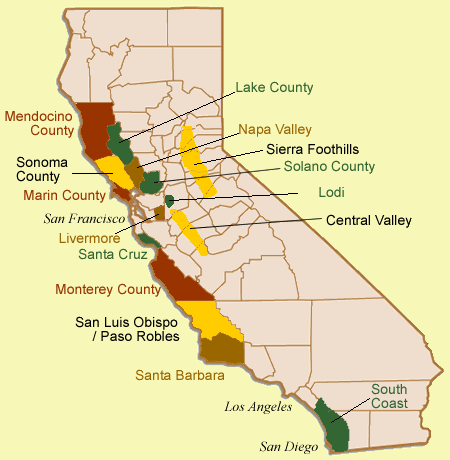
As I said in my original post, Rick had helpfully included a map of the major growing areas. That map highlighted such bastions of quality wine as the Central Valley. The map called out Marin County, which has just 7 acres of Cabernet Sauvignon planted, San Diego County which has 23 acres and even Santa Cruz County which you might be surprised to learn has only 12 acres of Cabernet Sauvignon planted (almost all the Cabernet Sauvignon grown in the Santa Cruz Mountains AVA is actually grown on the Santa Clara side of the appellation). But it did not include Santa Clara County or San Benito County, with over 500 acres planted between them.

The simple fact is this: If a self-declared "branding super freak", who works for a winery and is trying to promote Californian Cabernet Sauvignon, can somehow omit such a significant region then clearly there is a problem with that region's brand awareness.

So what can we do? Well if you believe as I do that the local wineries are worth supporting then sign up for the event. If you own or work for a winery, tell your mailing list about it; Donati Family in Paicines is offering a discount on their Cabernet just for this event. Then on February 11th let's all open some great bottles and tell the world about them.

Tuesday, January 19, 2010

What's wrong with this picture?

1 comments
EDIT: I realised I was quoting out-of-date figures; the post has been updated with the acreage from the latest NASS report for 2008.

On Thursday, February 11th there's a live Cabernet Sauvignon tasting planned. People all over the Internet are invited to open their favourite Cabernet Sauvignon and post tasting notes. It's organised by Rick Bakas, Branding expert and social Media director for St. Supery. There's even a map showing the major Cabernet Sauvignon producing areas.

Take a look. Notice anything?

The Santa Clara Valley isn't listed on it. Apparently they don't make Cabernet Sauvignon worth talking about in Santa Clara or San Benito counties.

They grow it in San Diego. In fact according to the official survey by the National Agricultural Statistics Service for 2008 they had a full 27 acres, plus there's 52 acres in Los Angeles. Marin County is a little smaller, with just seven acres planted. Solano County has a massive 361 acres. And don't forget that bastion of quality wine the Central Valley, home of Charles Shaw. Yeah, they grow an awful lot of wine there. (Or should that be a lot of awful wine?)

But Santa Clara and San Benito, with over 500 acres of Cabernet Sauvignon between them? Not listed.

There's definitely a message about branding here.

Tuesday, December 29, 2009

2005 Sycamore Creek Estate Cabernet Sauvignon

0 comments
Sycamore Creek is a winery with an uneven history. Since 2005 it's been owned by Bill Holt, who also owns the nearby Uvas Creek vineyard. This was their first vintage, with fruit from the old head-pruned Cabernet vines. Those vines were torn out this year and the vineyard is being replanted; the new vines will be properly trained but won't be producing for a few years.

This didn't taste as good as the last time I had it. Decanted and poured immediately. Nose of black fruits, vanilla and smoke. While there's plenty of good black fruit, this time it seemed overpowered by chewy oak and didn't seem to improve over the course of the evening. A big wine if you're an oak lover, but on this showing I couldn't give it more than 86. $28

Friday, September 25, 2009

2005 Martin Ranch "J.D. Hurley" Merlot, Santa Clara Valley

0 comments
The Redwood Retreat Valley is in the south west corner of the Santa Clara Valley AVA on the border of the Santa Cruz Mountains AVA; while the appellation boundaries generally follow the 600' contour at this point it dips to include the valley into the Santa Cruz Mountains.

Dan & Thérèse Martin planted Cabernet Sauvignon in 1993 and began making small amounts of wine in 1997. Initially the grapes were sold to Ahlgren, River Run and SCMV under the name Harvest Moon Vineyard; they later bonded as Martin Ranch Winery. Their first commercial release was in 2002 with the introduction of labels J.D. Hurley and Thérèse Vineyards wines. Dan is the primary winemaker for the J.D Hurley label.

The 2005 Merlot opens with an earthy, forest floor nose, with some floral and cocoa notes. On the palate there's initially a lot of acidity, but looking beyond that there is good black fruit, chocolate and a little smoke. The tannins are soft, with a medium length finish. Grows on you. 87. Listed at $20, the winery has it on closeout this month for $120 per case.

Tuesday, September 1, 2009

Dealing with the green meanies

1 comments
Sometimes a wine needs the right food pairing to show well. A light bodied wine that tastes thin and acidic alone might match well with a tomato pasta dish, and a full bodied, tannic red is a great match for a thick juicy steak.

Last weekend we had some friends over for dinner. I'd been to Costco and picked up some of their USDA Prime steaks; season them with salt and pepper, put them on the barbecue and eat them in the garden under the stars with a nice red wine, grilled vegetables and fresh bread. A perfect summer evening.

We'd had a spectacular 1990 Penfolds Bin 389 with the steaks, and followed that with a rather nice 2006 Stefania Uvas Creek Cabernet Sauvignon. It was still early, so I went to open something else, and pulled out a bottle of 2005 Fortino Santa Clara Valley Cabernet Sauvignon.

The nose had lots of sweet blackcurrant with a whiff of nail varnish in the background, but on the palate it was tart and tannic, with flavours of sour blackcurrant, oak and a 'green' streak that I didn't care for. We decided on reflection that we'd drunk enough for the night so I recorked it and put it in the fridge, thinking I'd probably cook with it.

The following night Alison had a tennis match, so while she was out I made a curry. I love hot, spicy Indian food with loads of methi (fenugreek) and fresh dhania (coriander/cilantro) but pairing it with wine is always problematic as the food tends to overwhelm them. Some people recommend spicy off-dry whites like Riesling or Gewurztraminer, but I'm not a huge fan of off-dry whites - I'll usually just have a beer or water.

Anyway, I spotted the opened bottle of Fortino Cabernet and thought 'why not?'. Surprisingly it worked; the green streak was masked by the herbs and the tomato and vinegar took care of the tartness. The blackcurrant fruit showed through quite nicely.

So the moral is, if you happen to open a bottle of wine and it's not to your taste, you don't have to decide between suffer it, throw it away or cook with it; with a bit of imagination the right food can make all the difference.

Monday, August 10, 2009

Tracking Vineyards

0 comments
I recently became curious as to just how many acres of vineyards there are in the Santa Cruz Mountains and Santa Clara Valley AVAs; surprisingly it's not an easy question to answer. Mapping county figures to the AVAs is tricky, as the AVAs cross county lines. According to the official figures from the National Agricultural Statistics Service there are just 377 acres of vines in Santa Cruz County, with 358 producing fruit in 2008. Similarly in Santa Clara County there are 1462 acres planted, with 1432 in production.

There are approximately 300 acres of vineyard in the Santa Clara AVA which lie inside the San Benito County border, and there is probably a similar amount of vineyard in the Santa Cruz Mountains AVA that lie within Santa Clara or San Mateo Counties. So at a rough estimate, there are probably around 700 acres of vines in the Santa Cruz Mountains AVA and at least twice that in the Santa Clara Valley AVA.

There are few large vineyards in the Santa Cruz Mountains; the rugged terrain isn't easily farmed. Anything over 20 acres is considered to be extensive. The largest, and most famous, is Ridge's Monte Bello Vineyard. This is in fact a number of smaller vineyards located at different elevations, giving a total of 108 acres. Other well known vineyards include Mount Eden and the Regan Vineyard owned by Bargetto, both of which are over 40 acres.

In Santa Clara Valley, most of the acreage is concentrated in a few large vineyards, several of which are located along Highway 152 in the San Ysidro District and Pacheco Pass AVAs. San Ysidro District lies to the east of Gilroy on Highway 152. While the AVA may be small at just 2,340 acres, it is home to two of the largest vineyards in the area. Mistral Vineyard and San Ysidro Vineyard sit side by side to the north of Highway 152.

Mistral is slightly the larger of the two, with 260 acres planted from a total of 375. It is understood to contain mainly Chardonnay and Merlot which is sold to large producers, though there is a small amount of the port grapes Touriga Nacional, Tinta Cao and Tinta Madeira. Until its sale in 2007 the vineyard was owned by Millbrook Wine of New York, through their Pebble Ridge Vineyards subsidiary. (I have yet to determine who the new owners are.) Millbrook also own the highly regarded Williams Selyem winery in Sonoma, who have produced a port-style wine from the vineyard. The San Ysidro Vineyard has around 250 acres planted. A little over half is Pinot Noir with the remainder being Chardonnay and a small amount of Merlot. It is owned by the San Ysidro Corporation, the parent company of United California Citrus.

Further along, just before the 152 meets the 156 is the Dunne Ranch Vineyard, the largest in the AVA. As the road rises towards Pacheco Pass the vineyards are to the right, in the valley below. This 1000 acre ranch is owned by the Blackburn family, who also own the Pietra Santa winery in nearby Cienega Valley, but if you have $20M to spend it's understood to be for sale. Pietra Santa use only a fraction of the fruit; the majority is sold. The vineyard has around 300 acres of Chardonnay, 66 acres of Gewurztraminer and 10 acres of Pinot Gris; this alone makes Chardonnay the most planted variety in the AVA, and also makes Gewurztraminer the second most planted white variety. The western portion of the vineyard lies within the Pacheco Pass AVA. Further still, and also within the Pacheco Pass AVA, lies the San Felipe Vineyard; it covers some 122 acres and is evenly divided into Pinot Noir and Chardonnay. It is also owned by the San Ysidro Corporation.

Between them, these four vineyards account for over 1,000 acres of vines, yet their names rarely appear on any labels. It's understood that much of the Chardonnay goes to large producers such as Kendall Jackson, Au Bon Climat and Beringer; the owners don't like to talk about who their clients are. Some fruit is used by local producers; Storrs, Picchetti and Cronin have all produced Merlot from San Ysidro, and Calera use Chardonnay from the San Ysidro and San Felipe vineyards.

I would be interested in any additional information about any of these vineyards; if you can help please contact me.

Saturday, May 30, 2009

2006 Clos LaChance Estate Grenache

0 comments
Earlier this week I visited the Clos LaChance tasting room. One of the wines on offer was the 2006 Estate Grenache and it didn't particularly impress. Cheryl from the winery left a comment on the blog to the effect that it must have been an off bottle and kindly sent me another one to sample.

I poured a glass and decanted the rest, which we drank over the evening. The wine has a nice garnet colour. Initially tight, it soon opened up and showed a pleasant nose of currant with a touch of smoke, but without the slight oxidation that marred the previous tasting. On the palate it's lively and fruity, with redcurrant and strawberry flavours, good acidity and significantly more tannin than before. According to the label it spent 16 months in barrel, but the oak influence isn't prominent. This is a wine that would pair well with poultry or paella and, while it didn't exactly rock my world, it was certainly a much better example than the last time. 88 $30

Monday, May 4, 2009

Sycamore Creek

0 comments
I've written about Sycamore Creek before, in particular their stellar 1978 Cabernet Sauvignon but this was my first visit to the winery. It's located off Watsonville Road, at the junction with Uvas Road. There's a narrow bridge over the eponymous creek leading into the vineyard; 10 acres of dry farmed head pruned old vines.

The current owners of Sycamore Creek, Bill and Carolyn Holt, also own the highly regarded Uvas Creek Vineyard, which is located a further mile down Uvas Road. Fruit for the wines is sourced from both vineyards and some is purchased locally. The Holts are gradually refurbishing the old vineyard and introducing new VSP trellising. All the wines with the exception of the Sauvignon Blanc carry the Santa Clara Valley appellation.

There are two tasting options; a flight of 5 current releases that is free and a flight of 5 reserve wines that costs $5. The fee is not refunded with purchase.

2007 Sauvignon Blanc, Monterey County
A lovely crisp, fruity Sauvignon Blanc. Nice herbal nose with notes of lime. Dry with mouth-watering grapefruit and lychee flavours. $17

2006 Chardonnay
Sourced from the nearby Vanumanutagi vineyard it clearly shares many characteristics with the offering from Fernwood Cellars. Rich aromas of creamy vanilla and butterscotch lead into sweet caramel and mango flavours and a long finish. $22

NV Uvas
A legacy of the previous owners, the Uvas is a blend of Cabernet and Chardonnay, with 3% Syrah added. It's an unusual combination, but it proved popular so has been continued. The nose shows blueberries and oak; on the palate there's the caramel notes from the Vanumanutagi Chardonnay combined with the berry flavours from the Cabernet. $18

2005 Syrah
The nose suggests fresh berries, smoke and English tea. Sweet flavours of blueberries and black olives, with a tannic finish. $18

2006 Mosaico
A Bordeaux blend, featuring all 5 grapes. Smoky, rustic nose with violets and brambles; flavours of brambles, blackcurrant and graphite witha good, structured finish. $25

2006 Carignane
Sourced from 100 year, old dry farmed Blake Family Vineyard on nearby Redwood Retreat Road
A smoky, dusty, earthy nose like a library or old wardrobe. Layered fruit; raspberry, sour cherry, allspice and new mown grass, with a tart finish. Nice structure; a good food wine. $21

2006 Cabernet Franc
New release. Aromas of black cherry and tobacco; Rich, sweet, silky black fruit, coffee and tobacco with racy acidity. $?

2004 Cabernet Sauvignon
Nose of leather, Cedar and spice. A big, tannic wine that needs time; great flavours of, blackcurrant and spicy oak. $20

2005 Estate Cabernet Sauvignon
A vibrant, smoky nose with berries and a hint of mint. Seemed smoother than 2004; nice cassis fruit, long finish and good structure. $28

2006 Petite Sirah
A typically inky, glass staining colour with a funky, barnyard nose. There's some good fruit backed by huge, chewy tannins. A wine to lay down and forget for a while. $20

2008 "Cabernet Blanc"
I confess I didn't get this. A rose of Cabernet Sauvignon, the label says "Late harvest"; it has 15% alcohol and 1% residual sugar. The wine was pressed after just 24 hours, giving a pale rose colour. It's got ripe, sweet flavours of wild strawberry and guava. To me a summer rose should be light with lithe acidity and relatively low in alcohol. This seems to be more of a get-your-date-tipsy kind of wine. $?

Kirigin Cellars

0 comments
Bonesio Winery was founded in 1916 in the Uvas Valley, though vines are believed to have been in place for at least 40 years prior. It was home to the Bonesio family until 1976; the main home is one of the oldest wooden structures in the county. The winery was noted for vintage dated Grignolino as early as the 1940s.

Nikola Kirigin-Chargin comes from a long line of Croatian winemakers. He studied oenology in Zagreb before emigrating to America in 1959. Following a career at San Martin, Almaden, Pirelli-Minetti, and Canadagua Wineries he retired and purchased the Bonesio Winery, renaming it Kirigin Cellars. In 2000, aged 84 he decided to retire properly, and sold the winery to Dhruv Khanna, one of the founders of Covad. Khanna's primary appears to be sports; he has used part of the land to establish the area's first regulation cricket pitch and has since added football (soccer) pitches.

The 30 acre vineyard is planted with several different varieties, including Cabernet Sauvignon and 50 year old Malvasia Bianca. The vines are trellised in the single wire "California Sprawl" system, where the canes are allowed to hang down the sides, shading the fruit. Proponents of the system say this prevents overheating, particularly in areas where the summers can get very hot, but nowadays most premium wineries employ a multi wire "VSP" system.

The winery has a historic plaque, ECV1850, placed by the esoteric Ancient and Honorable Order of E Clampus Vitus.

With the exception of the Estate Reserve all the wines carry the California appellation, even though the fruit is all either estate or sourced locally. Tasting is free; all the wines are generally available to taste with the possible exception of the Reserve. There's also a non vintage "Champagne" that I didn't taste.

2008 Sauvignon Blanc
A light, grapefruit nose and sweet flavours of grapefruit and kiwi. Seems to have some residual sugar. $15

2008 Chardonnay
Lemon nose, pear flavours and a slightly bitter finish. Dry $15

2008 Malvasia Bianca
Made from 50 year old vines, this could easily pass for Gewurztraminer. It has a similar spicy, flowery nose and crisp floral flavours, good acidity and a nice dry finish. My favourite of the wines tasted. $18

NV Estate Red
A blend of 60% Cabernet Sauvignon, 20% Pinot Noir and 20% Zinfandel. Has a light raspberry, fruit punch nose with some coffee. On the palate there's a medley of fruit; raspberry, loganberry and cherry. There's a dry, tannic, almost cardboard-like finish. $15

2006 Pinot Noir
A light cherry nose and rich flavours of bitter cherries. There's a slight hint of oxidation on the finish. $20

2005 Syrah
Plummy and slightly porty with dark fruits and hints of black pepper. Lots of tannin. $20

2005 Cabernet Sauvignon
The nose shows smoke, mint and menthol; on the palate it's chewy and tannic, with more mint and some eucalyptus. $20

2006 Reserve Cabernet Sauvignon, Santa Clara Valley
A smoky slightly oxidized nose. A big, structured wine with good blackberry flavours, but the oxidised note was offputting. $40

2007 Zinfandel
Raspberry on both the nose and the palate. Dry, tannic finish. $20

Vino di Mocca
Imagine one of those 'Ritter Sport' cocoa wafers in liquid form. Sweet, with nutty coffee, cocoa and tobacco notes. $20

Tuesday, April 14, 2009

2005 Storrs "Rusty Ridge" Zinfandel

0 comments
Critics often disagree over particular wines. It's understandable; after all, they are only human, and there can be any number of reasons, from bottle variation to a dislike of a particular style or a perceived flaw. But if I were to pick a particular vintage, let's say for example 2005, and a particular grape, such as Zinfandel, then you might reasonably expect critics to agree on whether it was a decent vintage or not. Surely you wouldn't be in the situation where one publication says it's one of the worst vintages in the past 25 years whereas another says it's a great vintage?

Well yes, actually, you would. As for me, so far I've been reasonably impressed with the 2005 Zinfandels that I've tasted, and the Storrs "Rusty Ridge" has raised the standard further. The fruit is sourced from a number of old head-trained, dry-farmed vineyards in the Santa Clara valley, across the eastern edge of the Santa Cruz Mountains. It's aged mostly in American oak with some French.

This is exactly what old vine Zinfandel should be about. Rich, concentrated raspberry aromas and flavours; not sweet, not overly hot despite the 15.2% alcohol, and enough tannin and acidity to support it all without ending up flabby. The oak is integrating nicely and there are secondary notes of pepper and spice. It retails for around $25-$30 and at that price I highly recommended it.

Tuesday, April 7, 2009

Stefania: Spring 09 releases

0 comments
I caught up with Paul and Stef Romero at a distributor tasting event in San Jose. (More notes from that event to follow.) They were pouring their latest releases, including their 2006 Santa Cruz Mountains Cabernet Sauvignon, sourced mainly from some smaller vineyards that they manage.

2007 Syrah, Eaglepoint Ranch, Mendocino
Having opened the 2005 last weekend; this was a good opportunity to try the other vintages. The 2007 sees a touch more oak than previous vintages; 1/3 as opposed to 1/4
It has a lovely floral nose, with black fruits. On the palate there's good fruit and a big twist of black pepper, particularly on the longish finish. Good acidity, nice balance.

2006 Syrah, Eaglepoint Ranch, Mendocino
A much brighter, fruitier nose than the 2007. On the palate there's more red fruits - redcurrants - than black. Nice finish, but less than the 07. While it's a nice wine, I prefer the 07.

2006 Cabernet Sauvignon, Uvas Creek Vineyard, Santa Clara Valley
Nose of blackcurrant jam on toast. Great, soft valley fruit - blackberry/blackcurrant, lovely rich mouthfeel and a good medium-length finish.

2006 Cabernet Sauvignon, Santa Cruz Mountains
Lots of mint and eucalyptus on the nose, backed by blackcurrant fruit. These come through on the palate too. The tannins are fine and soft, and the finish is longer than the Uvas. Great stuff.

Thursday, April 2, 2009

Aver Family

0 comments
Aver Family vineyards is an 8 acre estate off Watsonville Road in the Uvas Valley, near to Sycamore Creek and Jason/Stephens. It was part of a larger estate that had been supplying Cabernet Sauvignon and Petite Sirah to David Bruce, until the Avers purchased it in 2005.

John Aver immediately began with a major overhaul of the vineyard. The old "California sprawl" trellising was replaced by a modern VSP system. Some of the older vines were removed, others were grafted over to Grenache. There are currently 5.5 acres of vines of varying ages, roughly evenly split into Cabernet Sauvignon, Petite Sirah, Grenache and Syrah, with an additional acre yet to be planted. The farming is organic; although it's still in a transition phase the family intend to apply for official certification.

The wines are made at Crushpad's facility in San Francisco. 2006 is the first vintage; just 150 cases were produced, all from estate fruit. The plan is to gradually increase production to around 1,000 cases.

2006 'Homage' Syrah 25 cases, $35
Blended with 5% Petite Sirah and matured in 50% new French oak, this dark wine has a faintly smoky, coffee nose. On the palate there's bitter chocolate and good black fruit with nice acidity.

2006 'Heritage' Cabernet Sauvignon 100 cases, $44
On the nose there's very bright fruit; blackberries and a little heat from the 15% alcohol. A big wine with flavours of blackcurrant, brambles and spice. Nice balance and a long finish with chocolate notes.

2006 'Blessings' Petite Sirah 25 cases, $55
John Aver says he expects the Petite Sirah to be his flagship wine. As I've said before, the key with Petite Sirah is to keep the tannins in control, and he's managed to do that. It's got a nice nose of dark berry fruit and a smoky hint. Rich, concentrated flavours of blueberries with some smoke and spice. The tannins are clearly present but aren't overpowering. This does seem like a wine that would age well.

Overall an excellent maiden release for yet another new Santa Clara Valley winery. Future vintages will include a Grenache as well as a Durrell vineyard Chardonnay.

Sunday, March 29, 2009

Passport Day at Jason/Stephens

0 comments
Another winery that recently opened to the public is Jason/Stephens. It's one of a cluster of wineries located off Watsonville Road. Having tried some of their wines recently at Bella Mia I was curious to see what else they were making.

Being Passport day for Santa Clara Valley the place was buzzing; there was live jazz and a barbecue buffet, as well as the wines. The majority of the visitors seemed to be young women (marketers and single guys take note).

2007 Chardonnay $21
Good nose of lemon, apple and pear. Lively flavours of creamy lemon and vanilla with a chalky minerality.

2006 Merlot $24
Scents of chocolate and smoke. shows good blueberry and cherry fruit, nice acidity and soft tannins.