Showing posts with label Geyserville. Show all posts

Thursday, May 24, 2012

All That Jazz

0 comments
Ridge has been hosting quarterly tastings for wine bloggers for 3 years now. Tasting room manger Christopher Watkins always tries something new each time and for the most recent event he wanted to combine his love of music with his love of wine. So he came up with the novel idea of pairing wine with Jazz classics.

Now I'm no real Jazz aficionado; my dad was into big band stuff and he'd listen to the likes of Satchmo and Bird, but my tastes were more Santana and Budgie. Nevertheless I gave it a try while - more importantly - attempting to identify the four wines poured blind. If you're interested in the jazz aspect of the tasting then check out the Ridge wine blog.

Wine 1 showed lots of ripe red fruit; redcurrant, raspberry and liquorice. Incredibly rich and complex with herbal, minty notes and bags of smooth tannins. From the ripeness, complexity and the abundance of red fruits I assumed that it had to be a Zinfandel blend, but whatever it was I loved it. Eventually I guessed Geyserville; perhaps 2005.

Not even close; 2001 Monte Bello. Possibly the ripest vintage of Monte Bello ever made and recently upgraded to 99 points by Robert Parker. The clues were there in the herbal, minty and liquorice notes however I missed them because of the ripeness. Easily 96+ and insanely drinkable even at this early stage.

Wine 2 was smoky and earthy, with a hint of brett. Much lighter than the first (though not in colour), and dry with brambly black fruit and lots of tannin. Surely a Santa Cruz Mountains Cabernet; doesn't seem rich enough to be Monte Bello, so probably the Estate.

Pretty near the mark; the 2000 Monte Bello. A particularly cool vintage, hence the leaner fruit. Overshadowed somewhat by the riper wines on this tasting, but still a 92 point wine that'll give many old-world wines a run for their Euro.

Wine 3 had lots of dark fruit and earth; redcurrant and wild strawberry. I thought possibly Zinfandel but for some reason I convinced myself that it was the Lytton West Syrah.

Right vineyard, wrong grape. 1999 Lytton Springs - 70% Zinfandel, 17% Petite Sirah, 10% Carignane, 3% Mataro and absolutely 0% Syrah. Very, very tasty; 95 points.

Wine 4 had a bright raspberry nose with a floral note; lots of sweet fruit and a distinctly port-like note to it. At first I was sure it was a Zinfandel, but the port note started to nag at me and I wondered if it was Grenache; it has a tendency to oxidise and is often used for port style wines such as Banyuls or Australian 'stickies'.

Should have gone with my first instinct - 1997 Geyserville, and again not a drop of Grenache. That port note is down to a particularly hot year. 74% Zinfandel, 15% Carignan, 10% Petite Sirah, 1% Mourvedre. My least favourite of the four because of that port note, but still a 92.
While Christopher digested our song pairings we moved on to three wines from Ridge's new "classic vineyards" series. These were previewed at the previous bloggers' tasting, which I missed due to being in Europe. However I tried the Cabernet at the Monte Bello components tasting (and purchased all three).

The wines fit into a pretty large market gap between Monte Bello and the rest of the Ridge range. They were created to tie in with Monte Bello's recognition by the Historic Vineyard Society, and are named after some of the early viticultural pioneers who settled the mountain prior to prohibition. They deserve a detailed article of their own, so for now here are some brief notes.

2009 Perrone Cabernet Franc
Herbal, floral nose. Young, sweet red fruit - redcurrant in particular. The most structured of the three; this needs plenty of time. Could be superb in 10+ years. 93+
2009 Klein Cabernet Sauvignon
Sweet bramble, straw nose. Beautiful rich layered black fruit Less tannic than the Perrone, and the most drinkable of the three at present. 94
2009 Torre Ranch Merlot Floral nose, with plum and bramble. Dry cocoa, black fruit, liquorice, anise. Needs time to come together. 92+

Tuesday, March 6, 2012

Almost complete Ridge Geyserville vertical - part 3

0 comments
The third part of the Geyserville retrospective featured the vintages from 1988 through 1995. The group was joined by a special guest - Eric Baugher, assistant winemaker at Monte Bello. He joined Ridge in 1994 and so had worked on three of the vintages that we tasted.

It quickly became evident that the eight wines poured were all remarkably consistent. There were no Late Harvest outliers, no tired vintages, no flawed wines. What we got were eight superb examples of rich, well crafted wines which evolved and blossomed in the glass. Trying to choose between them was futile; each had its charm and every one was a delight. In the end the tasters submitted their rankings, but the final results were so close that the differences were statistically insignificant.


1988 Ridge Geyserville (82% Zinfandel, 5% Petite Sirah, 13% Carignan) 
The nose was dusty and oaky; at first I thought I got a whiff of cork taint, but it didn't persist. The palate showed tart raspberry and ham; I ranked it towards the end but it finished 2nd overall.

1989 Ridge Geyserville (75% Zinfandel, 22% Petite Sirah, 3% Carignan)
Complex nose showing soy sauce, meat, smoke and dried herbs. Nice raspberry flavours, with smoky oak and a rich, long finish, becoming more earthy with time. I really liked it; it finished 3rd overall. 

1990 Ridge Geyserville (64% Zinfandel, 18% Petite Sirah, 18% Carignan)
Compared to some of the others the nose on this was faint; notes of bramble and camp fire. Flavours of waffles, liquorice and bramble, with tannins that had softened with time but were still very evident. A youthful wine perhaps not yet at its peak. Finished 4th.

1991 Ridge Geyserville (50% Zinfandel, 20% Petite Sirah, 30% Carignan)
Initially the nose seemed musty, with ripe fruit and wood emerging with time. Plenty of sweet loganberry, perhaps a touch more residual sugar than the rest. It finished 8th, despite being Eric's first choice.

1992 Ridge Geyserville (65% Zinfandel, 15% Petite Sirah, 20% Carignan)
Opening with fresh earth and dark raspberry, an unusual camphor note developed with air. On the palate it showed opulent raspberry fruit; the Petite Sirah seemed particularly evident in the blend. Nicely balanced with light tannins it was the overall first choice.

1993 Ridge Geyserville (60% Zinfandel, 12% Petite Sirah, 22% Carignan, 2% Mataro, 4% Alicante Bouschet)
Deep nose of berry, cigar and orange peel; lots of black fruit - boysenberry, bramble and currant. Some tannin evident on the finish. 5th place.
 
1994 Ridge Geyserville (68% Zinfandel, 8% Petite Sirah, 20% Carignan, 4% Mataro)
Nose showed tart cranberry; flavours of raspberry and oak. Seemed a lighter, simpler example of the style. Overall 6th.
 
1995 Ridge Geyserville (62% Zinfandel, 18% Petite Sirah, 15% Carignan, 5% Mataro) 
At first the nose showed berry and smoke, but a savoury shiitake mushroom note soon developed. In the mouth there was lots of black fruit, particularly black cherry, and more of that savoury mushroom. One of my top three, it finished 7th.

As I said at the outset, there wasn't much to separate these wines. The results reflected that; for every person that had a wine as their first choice another had put it as their last. This is testament to the overall quality; averaging 20 years old not one was fading or flawed. from the previous tastings only the 1980 and 1987 could have held their own; the 1968, 1977 and 1978 from the first tasting would clearly have been outliers.
 
At some stage there will be two further flights, covering the vintages from 1996 to the present; I hope to attend those too and will report back.

Tuesday, February 21, 2012

Almost complete Ridge Geyserville vertical - part 2

1 comments
Ross Bott's epic 5 part Geyserville retrospective continued on Monday evening with a look at the vintages 1980 to 1987. Starting in 1978 Ridge had begun blending a small amount of Petite Sirah. This trend continues in most years, with 1985 seeing the first addition of Carignan.

I found this round much easier to rank than the first. There were two clearly outstanding examples, two that were either dead or flawed, or possibly both, and the rest fitted reasonably well between them, with no outliers like the 'late picked' wines from the 1970s. The wines all stated their acohol content within a 2% range. The overall results were far more consistent, with most of the group in rough agreement on the preferred order.


1980 Ridge Geyserville (100% Zinfandel, 14.6%)
The nose at first seemed woody and simple, but gradually developed to reveal some nice dried fruit. On the palate there was a mass of mature, dark raspberry fruit and a long finish. This was my favourite and was the evening's clear winner, with almost everyone ranking it in their top three.

1981 Ridge Geyserville (85% Geyserville, 15% Angeli, 100% Zinfandel, 14.4%)
The nose showed notes of brett and leather; brett showed on the palate too; perhaps a little too much but not overpowering. There was enough dried fruit to back it up. 5th overall.
 
1982 Ridge Geyserville (95% Zinfandel, 5% Petite Sirah, 12.6%)
There was an odd note to the nose reminiscent of a Gueuze, the Belgian lambic beer; almost medicinal. Some tart cranberry fruit, quick finish. I was surprised that it finished 4th overall. 

1983 Ridge Geyserville (95% Zinfandel, 5% Petite Sirah, 13.4%)
It was clear from the start that this one was dead. There was some discussion as to whether it was corked or oxidised or both. Beyond the obvious flaws there was some menthol on the nose and a hint of fruit still discernable, but it was no big surprise to learn that this was the 1983 and it finished last.

1984 Ridge Geyserville (90% Zinfandel, 10% Petite Sirah, 13.4%)
Nose of black raspberry; tart red fruit flavours and a brine note to the finish. I liked it rather more than the group did; it finished 6th overall.
1985 Ridge Geyserville (85% Zinfandel, 10% Petite Sirah, 5% Carignan, 13.3%)
The nose had candy notes, with 'red vines' and caramel and some dried herbs. Nice flavours of tart raspberry but a quick, drying finish and it seemed to be fading. Overall 3rd.

1986 Ridge Geyserville (84% Zinfandel, 10% Petite Sirah, 6% Carignan, 13.2%)
There was a very odd note to the nose that reminded me of some kind of air freshener or lavatory puck. It was dry, leafy and tart, improving slightly with time. There was some discussion as to whether the bottle was corked but I didn't think so. A disappointing showing from what should have been a good vintage. 7th

1987 Ridge Geyserville (88% Zinfandel, 4% Petite Sirah, 8% Carignan, 13.7%)
Like the 1980, the nose was at first not very expressive; faint notes of leather and fruit. But then mature blackberry fruit exploded on the palate followed by a nice herbal finish. A wine that seemed way younger than its 25 years. Both mine and the group's 2nd.


Sunday, February 19, 2012

Almost complete Ridge Geyserville vertical - part 1

1 comments

Leo and Evelyn Trentadue owned a fruit orchard in Sunnyvale, producing apples and cherries. In 1952 they purchased the abandoned Perrone winery and vineyards on Monte Bello Road as a peaceful retreat.
In 1959 the Trentadues sold their orchards and bought a 208 acre property in Alexander Valley with 68 acres of old vines, some dating back to about 1880. That same year the neighbouring Torre Ranch was purchased by a group of friends who established Ridge Winery.

As Ridge became well established they looked to expand, and saw the neighbouring Trentadue property, together with its old Perrone winery buildings as the obvious next step. Negotiation culminated in an agreement to purchase not just the Monte Bello property but also fruit from the Trentadue Ranch vineyard in Geyserville, and in 1966 the first Ridge Geyserville Zinfandel was produced. This wine soon established a solid track record for quality and ageability.

As was typical for vineyards of that era the vines are a "field blend", including Zinfandel, Petite Sirah, Carignane (Ridge's preferred spelling) and Mourvèdre, which Ridge call Mataro.

Note the red foil on the 1968.
I recently joined Ross Bott's bi-weekly tasting group for the first in a series of tastings covering an almost complete vertical of Ridge Geyserville bottlings. As is usual in these tastings the wines are served single-blind. Participants rank the wines in order, and Ross computes the overall ranking, whereupon the actual wines are revealed.

Note the design of the 1970 cork
The wines were not decanted; they are left to stand for a few days and then opened and "Bott poured" into a small beaker with the minimum of agitation; the measure is then poured into each taster's labelled glasses. In this way the sediment gets disturbed as little as possible, and everyone gets an equal taste. All the wines are on the table at once, so it's up to each taster to decide what order to taste them. The tasting usually goes on for around an hour before the scores are tallied.

Despite the significant age of the wines and the fairly shocking state that most of the corks were in, it's impressive that not one of the wines poured appeared corked, oxidised or flawed in any way. Several tasters, myself included, commented on how difficult it was to rank the wines.


1968 Ridge California Zinfandel
Poured first; this wine had the lightest colour of the wines poured. That plus a lovely terracotta hue was the clue that it was the oldest; this was the only one in the line-up made by Dave Bennion prior to Paul Draper's arrival at Ridge the following year.
The nose was amazing; at first showing smoke and perfume before developing an Indian spice note (asafoetida?). On the palate there was initially sweet raspberry fruit backed by an earthiness. As time went on the fruit faded and became more herbal, with the earth and acidity showing more. By the end it began to tire, but at its peak it was stunning; truly sublime. Because of that peak I rated it my #1, but overall it ranked 4th.

1970 Ridge Geyserville
Nose showed prune and dried berry. Poured last, this seemed simpler than the rest with some nice raspberry fruit and some residual sweetness; I had it pegged as one of the 'Late' wines - presumably if Ridge had used that designation back then it would have applied. Seemed higher in alcohol; this turned out to be the case, coming in at 15.6%. Overall ranked 7th

1972 Ridge Geyserville At first this appeared darker than the rest, but that turned out to be mostly due to sediment. The nose was dusty, like cardboard or old books. On the palate there were tart cranberry flavours and it seemed somewhat acidic and unbalanced whan judged against the rest of the flight. My least favourite; it was placed 9th overall, despite receiving one 1st place and two 2nd place votes.

1974 Ridge Geyserville
The nose on this also had a musty cardboard note which initially made me suspicious that it was corked, but in the mouth there was plenty of fruit - bramble jelly with earthy notes and a long finish. Overall 3rd

1975 Ridge Geyserville Late Picked
The nose on this showed some funk; smoky and earthy. Perhaps a hint of brett; not enough to be unpleasant, just enough to spice it up. Initially I got lots of rich leather; as time went on the black fruit came out. I really liked it and rated it in my top 3, but some of the other tasters didn't and ultimately it came in 8th.

1976 Ridge Geyservill, Old Hillside Vineyards
The nose was light, showing some dried fruit. Nice fruity flavours of black raspberry and boysenberry, though it began to fade fairly soon. Very much in the middle of the pack - it was the only wine to receive no first place votes and one of three to receive no last place votes - overall it was ranked 6th.

1968 is on the left. The darkest G is mostly due to sediment
1977 Ridge Geyserville Late Harvest
We knew that one of the wines carried the designation 'Late Harvest' and this was the prime suspect. The nose was sweet and portlike; this followed through in the mouth with nice flavours of dried cherry and wild strawberry. Just a hint of residual sugar; certainly no more than some others, and it didn't show the heat as you might have expected. Clearly an outlier in this group, but very popular; it finished 2nd.
This was the first of the wines to indicate varietal composition - 100% Zinfandel.

1978 Ridge Geyserville Late Picked
The 1978 and 1979 labels both indicate that the blend included 5% Petite Sirah. Nose showed lots of toasted bread and earth, in the mouth there was lots of rich brambly fruit and leather notes. Surprisingly youthful, it continued to evolve with time and it wasn't much of a surprise to discover that this was from the excellent 1978 vintage. Finished 1st

1979 Ridge Geyserville
The nose was toasty and meaty, with gamey notes. The palate showed nice blackcurrant fruit and a longish rich, savoury finish. Overall it finished 5th.

I want to thank Ross for organising the tasting and sourcing the wines, Tom for hosting and Michael for generously providing the 1968. I'm very much looking forward to the next event covering the 1980s.

Sunday, October 23, 2011

Ridge Zinfandel Pairs 1978-1990

0 comments
Ross Bott runs a tasting group that meets twice a week, on Mondays and Thursdays. The theme for this tasting was Ridge Zinfandels. There were two different wines from four vintages; 1978, 1983, 1985 and 1990. As usual the wines were poured blind, though we had a list of the wines beforehand. The wines were not decanted prior to serving.
The colours of the wines were all remarkably consistent; despite each one being at least 20-30 years old they still tended more towards garnet than brick.

A (1985 Geyserville) - Ranked 3rd overall, no first place votes
The nose was initially musty, though this faded with time. Notes of leather, with raspberry becoming increasingly evident as the mustiness faded. Nice raspberry fruit, with the tannin and acidity well balanced, and a dry finish. Was fading a little by the end.

B (1985 Howell Mountain) - Ranked 4th overall, though it did receive 2 first place votes.
Rich, brambly nose with a herbal note Bright red fruit - raspberry and cranberry, with an earthy 'old world' finish. Held up well

C (1978 York Creek)- Ranked 2nd overall, with 1 first place vote.
Nose showed matchsticks, mushrooms and leather. Mature with flavours of black fruit, coffee, cola and strawberry. Some leather, and a long finish.

D (1990 Geyserville) - Ranked 7th overall.
The nose wasn't great (I wrote 'stinky') - earthy and leathery. There was some debate as to whether it was corked, but it was certainly flawed in some way. Some sweet, ripe, pruney fruit and what I took for brett on the finish

E (1990 Lytton Springs) - Wine of the night; only 4 tasters did not rate it #1 which is almost unheard of at an event like this.
Ripe fruit on the nose, with floral notes. Palate shows loads of rich, sweet fruit - blackcurrant and raspberry - and a long finish. An awesome wine; easily 95+ points.

The last three wines were all a bit disappointing. Unsurprisingly 2 of the 3 were from the weakest vintage: 1983.

F (1978 Langtry Road) Rated 6th overall, despite getting one first place vote.
If I hadn't known that all these wines were Zinfandels I'd have called this as a Petite Sirah. It does in fact contain 30% Petite Sirah as well as 10% Carignane; I think labelling rules were more flexible back then. 
It had the darkest colour of all the wines; nose showed some barnyard and earth. There was some black fruit but this was dominated by some monster tannins. Somewhat unyielding initially, though it did soften a little as time went on.

G (1983 Park-Muscatine, Howell Mountain) - Rated 8th 
The nose was light, with floral, berry and smoky notes. On the palate there was some raspberry and bramble, but it was light, tart and tannic.

H (1983 Geyserville)
The earthy nose showed a 'porty' note. As with the previous wine (from the same vintage) it was light with some brambly fruit. Seemed a bit oxidized, though it still had some tannins left.

Afterwards we were treated to a delicious 1978 Dusi Late Harvest, with 10% residual sugar and 14.2% alcohol.
Colour of amber/tea. Great mature nose with raspberry and port notes. Great flavours of raspberry, coffee, cocoa, fig and dark chocolate backed by nice acidity. 94 points

Thursday, March 31, 2011

Ridge Bloggers tasting, March 2011

0 comments
Has it really been 3 months since the last Bloggers' event? Once again, Chris Watkins invited a group of wine bloggers to a tasting of current, unreleased and library wines at the Monte Bello tasting rooms. A dozen of us braved torrential rains and hailstones; some of the regulars were joined by Chiara Shannon of K&L Wines, Melanie Friedman and Erin Grant.


Chris likes to have a different theme for each event, and this turned out to be a demonstration of how Ridge wines age over decades.

We began with a couple of the newly releases. Ridge has dropped the "Santa Cruz Mountains" designation in favour of "Estate" for both the Chardonnay and the red blend, which is now a fully fledged Cabernet.

2009 Estate Chardonnay
Nose shows peach, apricot, a touch of of almond and creamy vanilla. On the palate there's sweet white fruit up front, and a salty note. There's some bitterness from the oak and tannin on the finish; it needs a little cellar time. 90+

2008 Estate Cabernet Sauvignon
Earthy nose with blackcurrant, mint and herb. Tart fruit flavours of bramble and blackcurrant backed with earth and smoke. Good structure; firm tannins on the finish. Nice now, but will repay cellaring. 92

We moved on to a 10 year comparison of Geyserville - the newly released 2009 vintage and the 1999 from the library.

2009 Geyserville
The 44th vintage is a blend of 74% Zinfandel, 17% Carignane, 6% Petite Sirah, 2% Alicante Bouschet and 1% Mataro.
The colour is a bright red-purple. The nose is tart, with a medicinal note. Flavours of cherry and redcurrant, with bright acidity. 91 It's a nice wine, but it was completely overshadowed by

1999 Geyserville
Blend of 68% Zinfandel, 16% Carignane and 16% Petite Sirah.
A deep brick red colour. Lovely mature nose and great flavours of dark fruit, dried cranberry, leather. There's amazing depth and a long finish. 94

This was followed by three impressive vintages of Monte Bello spanning two decades.

1985 Monte Bello
93% Cabernet Sauvignon, 7% Merlot
Similar deep brick red colour to the Geyserville.
Aromas of leather, dried fruit and hayloft; palate showed earth with some blackcurrant (but not a lot), and savoury, meaty notes. Still a surprising amount of tannin on the finish.
The fruit showed more clearly when tasted alongside food. After the tasting was over I went back and retasted all the Monte Bellos and was surprised by how the fruit showed - here's a 25 year wine that needs air to show its best. 95

1995 Monte Bello
The nose was musty and earthy, with notes of menthol. The palate showed lots of bright acidity and earth, hiding the fruit, and lots of tannin. It seemed shut down tight and I wasn't going to assign a rating, but revisiting after a couple of hours the fruit came out - great, rustic brambly and herbal notes. Clearly many years from its peak. 94+

2005 Monte Bello
This wine has always been a delight; the nose is big and fruity, with mint and earth notes. On the palate there's lots of intense black fruit - blackberry, blueberry and blackcurrant, with graphite, smoke and pepper - the finish just goes on and on. With air it got even better and showed a liquorice note. The best young Monte Bello I've tasted. 97


We then moved to two examples from the ATP programme, which focuses mainly on Rhone varieties.

2004 Lytton Estate Syrah
Cofermented with 10% Viognier, and blended with an additional 8% Grenache.
The nose shows spicy, peppery red fruit which follows through onto the palate. Notes of redcurrant, tobacco and allspice. 91

2006 Lytton Estate Syrah
The 2006 is not yet released. The nose is altogether more assertive than the 2004 and overall there's significantly more going on; lots of red fruit and spice with a long finish. Definitely one to watch out for. 94

Alan Bree then teased us with two blind wines from his extensive personal Ridge cellar. He firmly believes that all of Ridge's wines deserve cellaring and are typically consumed too young. We had no other clues as to what was being offered.

Both wines had a similar brick red colour to the 1999 Geyserville and 1985 Monte Bello, so my guess was that the wines were 10-15 years old.

The first had a light nose that suggested cigarette smoke. Nicely mature, with notes of sweet raspberry fruit and some good tannins. The raspberry and tannin made me guess a Zinfandel blended with Petite Sirah. (Dead wrong)

The second showed a slightly redder colour, suggesting that it was the younger of the two. There was a sour note on the nose that I didn't care for, but the flavour was surprisingly sweet. Again a raspberry note made me think it was a Zinfandel, but the tannins were much softer.

The wines turned out to be 1997 and 1998 Sangiovese, from Dry Creek Valley. The 1997 was blended with 17% Merlot, while the 1998 was 100% Sangiovese. I would never have guessed this as I was unaware that Ridge had ever made a Sangiovese. (Apparently they took over the vineyard in 1997 and replanted it in 1999.) Two fascinating wines, probably slightly past their peak despite the tannins on the 1997, but still interesting and tasty. I didn't score them at the time, but in retrospect I'd probably say 89 each.

Sunday, March 21, 2010

Bloggers vs Bob - a tasting at Ridge

0 comments
Chris Watkins, tasting room manager at Monte Bello and Ridge's blogger-in-chief, recently invited a few local bloggers up the mountain for what is hopefully the first in a regular series of events. As you probably know, the influential critic Robert Parker Jr recently reviewed some recent vintages of Monte Bello for the first time in several years. Chris thought it might be interesting to get the opinions of some of us wine blobbers as Mr Parker disparagingly calls us, and see how our opinions equated to those of His Bobness.

Never ones to decline an opportunity to drive up the beautiful mountain, my friend Wes Barton and I headed up on a glorious spring morning. Also in attendance were Thea "The Wine Brat" Dwelle, Amy Cleary, Gary "Iron" Chevsky and Liren Baker

I've added Mr Parker's scores where available. For the record I was pretty sure I could quote his scores for the Monte Bellos but couldn't remember what he'd scored the others beyond the fact that I thought they were all 90+
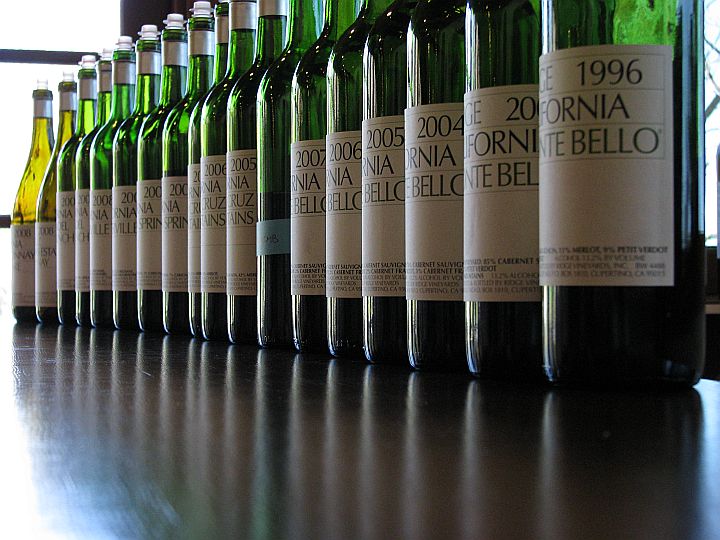


We began with a couple of whites. Jimsomare is the lower of the Monte Bello vineyards, lying below the fog line. The 500 acre ranch has supplied fruit for over 40 years and is currently under a 30 year lease. In the past Ridge have made both Cabernet and Zinfandel from the vineyard, but this is the first Jimsomare designated Chardonnay.
In 2008 the Chardonnay yields were quite good. During the selection for the Monte Bello and Santa Cruz Mountain Chardonnays it became evident that a few lots showed a particular character that didn't fit the profile. In all around 8 barrels were identified, and as a result this one-time blend was created. As yet unreleased, it will probably be priced below the Santa Cruz Mountains, in the mid $30s.

2008 Jimsomare Chardonnay, Santa Cruz Mountains
14.8% alcohol. Typical pale straw colour that Ridge Chardonnays usually have.
Nose shows tropical fruit, lemon and fig. There's some minerality, but less than usual. On the palate it's creamy and smooth, with lemon and sweet green apple. Nice longish finish, with a hint of caramel. Showing well for a young Ridge Chardonnay - one to drink young. 91

2008 Santa Cruz Mountains Chardonnay
Nose shows lemon, pear and toasty oak. There's significantly more acidity than the Jimsomare, and more minerality, with less immediate richness and a crisp, lemony finish. This needs a year or two. 91+

Now on to some flights of Zinfandel. The East Bench comes from a vineyard in Dry Creek Valley that is newly replanted with cuttings taken from Lytton Springs. The first vintage was in 2006.

2008 Zinfandel, East Bench, Dry Creek Valley
Not yet released.
Light, herbal nose with raspberry and cherry notes. Lots of tannin, flavours of "red vines" and liquorice; there's some good bright acidity but a fairly short finish. 87 (RP90-92)

We were supposed to be tasting the 2007 East Bench too, but it was unavailable so the 2006 was substituted. Just out of interest, here's my note on the 2007 from a tasting in January:
2007 Zinfandel, East Bench, Dry Creek Valley
Ripe nose, with raspberry and date. Big, rich brambly fruit with a herbal note. Good structure, tannin shows on the finish. 90
(RP90+)

2006 Zinfandel, East Bench, Dry Creek Valley
A more expressive nose than the 2008, with spicy oak and sweet berry aromas. In the mouth it's rich and smooth, with lovely raspberry and spice flavours. 89

Geyserville and Lytton Springs are the pinnacle of the Ridge Zinfandels. Two very different wines, each is a field blend which often contain less than 75% Zinfandel and thus are no longer explicitly designated as such. Both have an enviable track record for ageability; typically I find the Lytton Springs to be more approachable when young.

2008 Geyserville, Sonoma County
20% Carignan 6% Petite Sirah, 2% Mataro
Smoky nose, with dark, brambly fruit. Full bodied and a good mouthfeel and nicely balanced. Complex flavours of raspberry and black fruits. Dry, astringent finish. Drink some time after 2012 92 (RP90-92)

2007 Geyserville, Sonoma County
22% Carignan, 18% Petite Sirah, 2% Mataro
There are toffee, cedar and floral notes on the nose. A dark and brooding wine, with the additional Petite Sirah really showing. Lots of chewy tannin partially masks the black fruit; here's a wine that needs 3-5 years to show and will last 20+ years. Tough to rate; right now for me it's a 91+ but in time will most likely rate 2-3 point higher. (RP91)

2008 Lytton Springs, Dry Creek Valley
21% Petite Sirah, 5% Carignan
This had a lovely brambly, raspberry, spicy nose. Very fruit forward, with concentrated raspberry, black cherry and allspice. Showing well now but posessing enough structure to merit ageing. 92 (RP91-93)

2007 Lytton Springs, Dry Creek Valley
The nose is more integrated nose than the 2008, with dark brambly fruit and smoky oak. Good concentrated fruit and a fairly long, tannic finish.. More structured than the 2008, this needs 2-3 years. 92+ (RP92)

Then we switched to the local juice. Starting in the late 1970s Ridge began producing a second Cabernet Sauvignon called the Santa Cruz Mountains Estate. Lots that were considered too fruit-forward, less structured went into this second label.
Starting with the 2000 vintage the wine developed a specific identity, becoming a blend that typically contains around 40% Merlot and under 60% Cabernet. Consequently the Santa Cruz Mountains is no longer designated as a Cabernet Sauvignon.

2007 Santa Cruz Mountains Estate
58% Cabernet Sauvignon, 42% Merlot.
Big nose of blackcurrant, menthol and coffee. Lots of plum and blackcurrant backed by nice herbal notes. Great fruit without being too fruit-forward; nice structure - lot of tannin on the finish. A great food wine; approachable now with air but will repay cellaring. 93 (RP88)

2006 Santa Cruz Mountains Estate
56% Cabernet Sauvignon, 42% Merlot 2% Petite Verdot
Nice bright nose - lots of blackcurrant. The small amount of Petite Verdot contributes some floral violet notes. Initially very tannic, though there's good fruit in the background. Nice notes of grilled meat and dried herbs. Needs time. 91 (RP91)

2005 Santa Cruz Mountains Estate
58% Cabernet Sauvignon, 42% Merlot.
Elegant nose; meaty, brambly and smoky, with a touch of mint. This is now nicely integrated; the tannins are much smoother than the younger examples. Tart brambly, blackcurrant fruit and a good, longish finish. Everything is in the right place. 93+ (RP92)

And finally a wonderful vertical of young Monte Bellos. We began with a barrel sample of the 2008 and ended with an interesting older example.

2008 Monte Bello, Santa Cruz Mountains Barrel sample
A blend of 72% Cabernet Sauvignon and 28% Merlot. None of the Petite Verdot or Cabernet Franc made the final selection.
Savoury nose; ash, brambles, red currant and meat. On the palate there are soft, silky tannins and smooth black fruit. Unsurprisingly it's still very primary. 91-94 (RP94-96)

2007 Monte Bello, Santa Cruz Mountains
This was only opened that morning and on the initial showing I can see why Parker didn't rate it as highly as I did.
The nose showed smoked meat, black fruit, mint, pencil shavings. In the mouth there is concentrated black fruit but it's very tight and not showing anything like as well as it did the last time I tried it.
So having tasted though the rest of the line-up I came back to it. By then it had opened up quite a lot and was showing far more fruit and less of the tannin. Still very primary, but good delineation, nice black fruit and a long finish. I'm right, Parker is wrong. 95+ (RP92)

2006 Monte Bello, Santa Cruz Mountains
Nose is floral, with violets and black fruit. Silky tannins, great black fruit and nice herbal notes with a longish finish. 93+ (RP94)

2005 Monte Bello, Santa Cruz Mountains
What a great nose this wine has. Intense and smoky, with rich black fruit. On the palate it's very concentrated and chewy. Wes had warned that the last bottle he had was closing down, but there was no sign of that here. Full bodied, rich and smooth, elegantly structured with great black fruit and a long lingering finish. Amazingly drinkable right now for a young Monte Bello, but try to keep your hands off it. A true classic. 96+1 (RP97+)

2004 Monte Bello, Santa Cruz Mountains
Interesting grassy, straw nose with some blackcurrant fruit. In the mouth it's tannic, herbal and earthy, with some bell pepper notes and a dry, medium length finish. This is the only release I've passed on since 2001; it will be interesting to see what happens in 10 years. 91 (RP91)

2003 Monte Bello, Santa Cruz Mountains
The nose had an unusual 'grain silo' note, along with the typical black fruit and violets. Smooth rich fruit - blackcurrant blackberry, coffee and camphor. Tannins are pronounced on the finish. 94 (RP95+)

1996 Monte Bello, Santa Cruz Mountains
Deep brick red colour. The nose has signs of brett, with earthy, barnyard and leather notes. There are layers of rich fruit; black berry, pomegranite, cherry. The hint of brett also provides interesting secondary flavours of leather and cigar box. Smooth, fine tannins. Long finish.
Still very youthful; hopefully the brett won't continue to develop and end up overpowering the wine. Worth keeping an eye on. 94

I'd like to thank Chris and Darren for hosting us and opening such an array of great wines. Here's hoping that this turns out to be a regular event.

1 Just as an aside, since I adopted the 100 point scale 96+ is the highest score I've awarded.